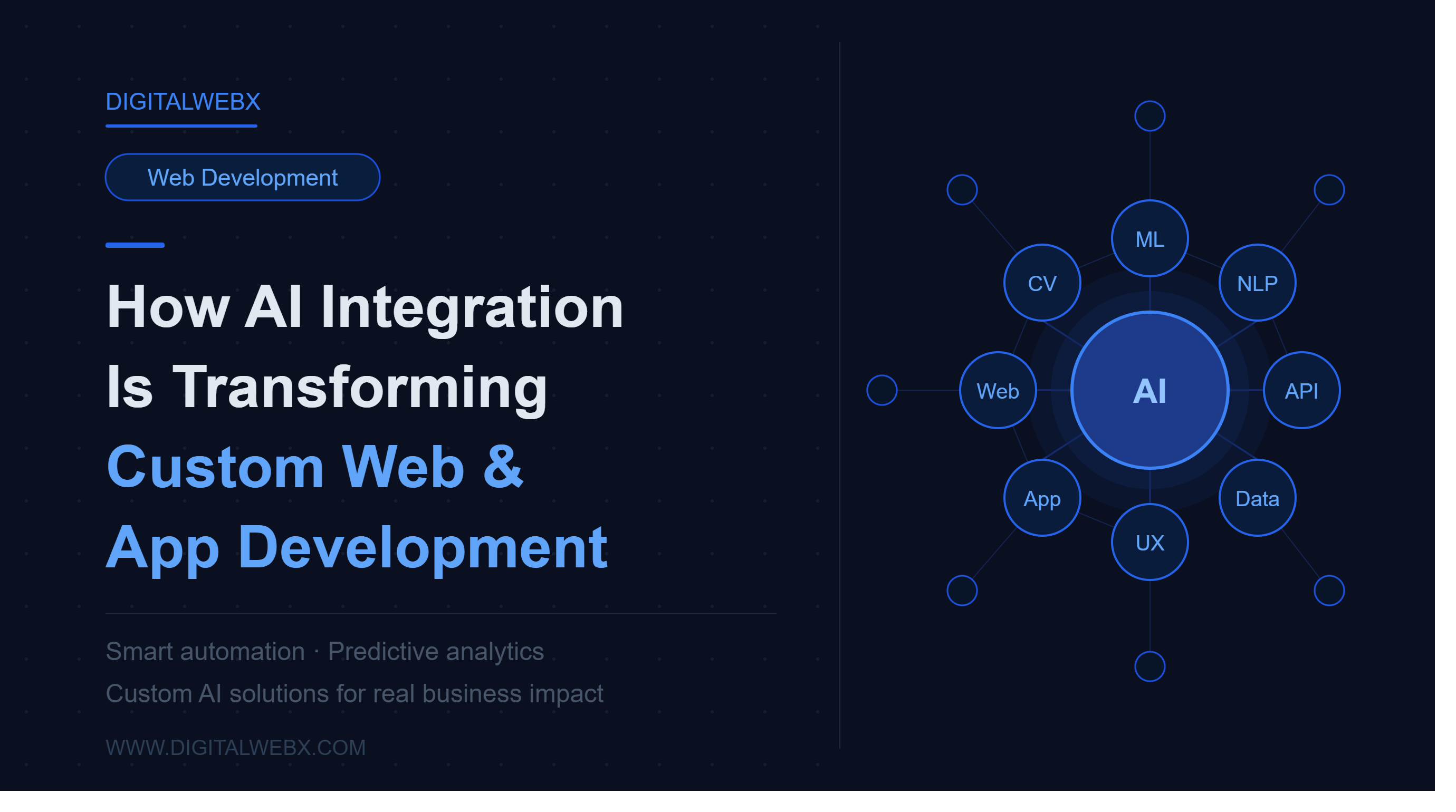
How AI Integration is Transforming Custom Web & App Development Your competitors are not
just building faster software. They are building smarter software — software that learns, adapts,
and makes decisions without waiting for a human to click a button. If your current web or mobile application cannot do that, you are not behind on a trend. You are behind on a business advantage. The companies winning in their respective markets right now — from fintech to healthcare to logistics — share one common investment: purposeful AI in app development. Not AI for a press release. AI that eliminates bottlenecks, personalizes user experiences, and surfaces insights that used to require an entire data team. This post breaks down exactly how that happens, what it means for your bottom line, and how DigitalWebX builds it for you. What AI Integration Actually Means for a Business Application Let's be precise. AI integration is not about wrapping your app in a chatbot widget and calling it "intelligent." It means embedding AI capabilities — machine learning models, natural language processing, computer vision, or predictive engines — directly into your application's core workflows. The result: your software stops being a tool your team operates and starts being a system that operates alongside your team. 5 High-Impact Use Cases That Deliver Real ROI 1. Smart Process Automation Beyond Simple Rules Traditional workflow automation is rule-based: if X happens, do Y. That breaks the moment an exception appears. AI-powered automation handles nuance. It learns from patterns and handles edge cases that rigid rule engines cannot. Business impact: Invoicing, onboarding, and document processing workflows run without manual intervention Exception handling that previously required a manager's judgment gets resolved by the model Operational costs drop significantly — teams can scale without proportional headcount growth 2. Predictive Analytics Built into the Product Instead of pulling reports from a dashboard and then making a decision, your application makes the prediction for you — before the opportunity closes or the risk materializes. Real-world examples: An e-commerce platform predicts which users are likely to churn and triggers a retention campaign automatically A logistics app forecasts delivery delays three days out, rerouting shipments proactively A SaaS product identifies accounts at risk of downgrade and alerts the customer success team in real time 3. Personalization at Scale Personalizing the user experience manually is not scalable beyond a few hundred users. AI makes it scalable at hundreds of thousands. What this looks like in a custom app: Content, pricing, and product recommendations that adapt to each user's behavior Dashboards that surface the most relevant KPIs for each role automatically Communication sequences personalized to where each customer is in their lifecycle This level of personalization was previously available only to companies with dedicated data science teams. AI in app development makes it accessible to mid-market businesses through purpose-built integrations. 4. Intelligent Search and Natural Language Interfaces Your users should not need to learn how your software is organized. They should be able to ask it a question — in plain language — and get an answer. Embedding NLP-powered search or conversational interfaces inside your custom application reduces training time, lowers support tickets, and dramatically improves user retention. 5. Computer Vision for Industry-Specific Workflows If your business involves physical assets, quality control, documentation, or visual data of any kind, computer vision is a direct revenue lever. Applications: Construction and real estate platforms using image recognition for site progress tracking Manufacturing apps that detect defects in product images before shipment Healthcare platforms automating document classification from scanned files Why "Off-the-Shelf AI" Is Not the Answer for Your Business There is no shortage of AI SaaS tools. The problem is not access — it is fit. Generic AI tools are built for generic workflows. Your business has specific data, specific logic, and specific compliance requirements. Plugging a generic solution into a custom product creates: Data silos — your AI doesn't have access to the context it needs to be accurate Integration debt — workarounds and middleware that add fragility to your stack Vendor lock-in — you are dependent on a third party's pricing, uptime, and roadmap Custom AI solutions built into your application architecture eliminate all three. The model is trained or fine-tuned on your data. The integration is native, not bolted on. And the IP is yours. Tech Note: How DigitalWebX Handles AI Integration For founders who want to understand what's happening under the hood — without needing a computer science degree. When DigitalWebX integrates AI into a client's application, the process follows a structured, risk-controlled framework: Step 1 — Use Case Prioritization We do not integrate AI everywhere. We identify the two or three workflows where AI will generate the highest measurable return and start there. Step 2 — Data Audit and Pipeline Design AI is only as good as the data feeding it. We audit your existing data sources, identify gaps, and design the pipelines needed to feed the model clean, structured inputs. Step 3 — Model Selection or Fine-Tuning Depending on your use case, we either integrate a pre-trained foundation model (such as OpenAI, Google Gemini, or open-source alternatives) via API or fine-tune a model on your proprietary data. The choice depends on accuracy requirements, data sensitivity, and cost targets. Step 4 — Secure Integration into Your Application Layer AI components is integrated at the API and service layer of your application — not as front-end patches. We implement role-based access controls, data anonymization where required, and audit logging so your AI decisions are always traceable. Step 5 — Monitoring and Continuous Improvement AI models drift over time as data changes. We implement monitoring dashboards that track model accuracy in production and trigger retraining cycles before performance degrades. As a leading AI web development company in India, DigitalWebX has applied this framework across sectors including fintech, healthtech, edtech, and B2B SaaS — delivering integrations that are production-grade from day one. What Business Leaders Should Demand Before Signing an AI Development Contract Not every development agency has the depth to build AI responsibly. Before you commit, verify that your vendor can answer these questions clearly: How will the AI model be trained or fine-tuned on our specific data? What happens to our data — is it used to train the vendor's other clients' models? How do you handle model drift and performance degradation post-launch? Can the AI decisions be explained and audited, especially in regulated industries? What is the architecture for scaling AI inference without performance bottlenecks? If the answers are vague, the implementation will be too. The Window to Build This Competitively Is Narrowing AI in app development is not a future capability. It is a current differentiator. Businesses that integrate AI into their core product workflows today will have compounding advantages — better data, better models, and better unit economics — by the time competitors start. The good news: you do not need to be a technology company to build AI-powered software. You need the right partner. Ready to Build Something That Thinks? DigitalWebX specializes in custom AI solutions for ambitious businesses that want software built to outperform — not just to function. Whether you are starting from scratch or adding AI capabilities to an existing platform, we bring the technical architecture and domain experience to deliver integrations that are production-ready, secure, and built around your specific business logic. Schedule a Strategy Call with DigitalWebX → Tell us where your biggest operational bottleneck is. We will show you exactly how AI solves it — and what it would take to build it.
#AI in app development#Custom AI solutions#AI web development company India#AI web development trends 2026#Artificial intelligence in web design#Custom software development India#AI integration services#Enterprise app development
A
Written by Ankit Kumar
DigitalWebX Author

💬 Comments (0)
Leave a Comment