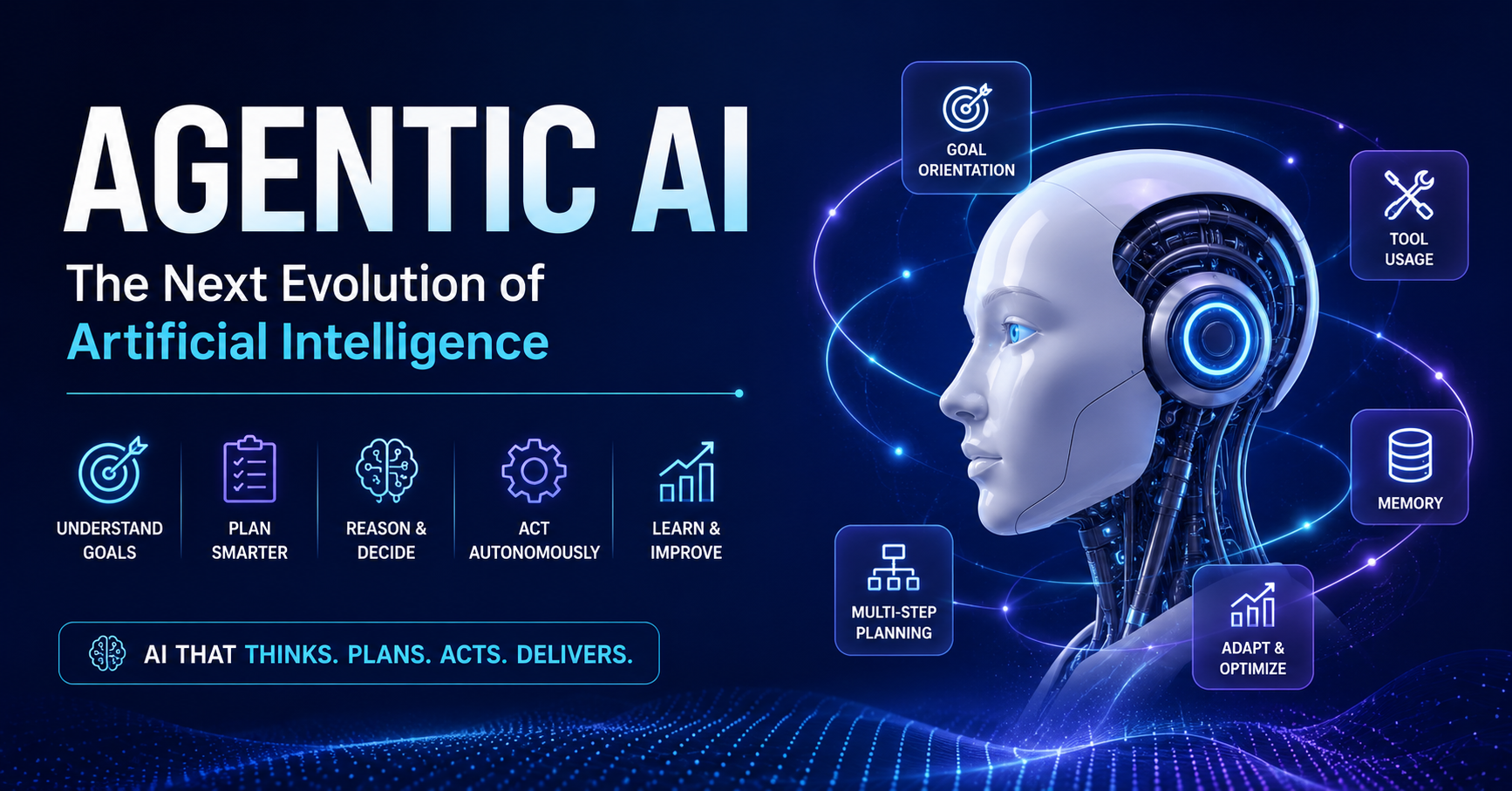
What is Agentic AI?
Agentic AI refers to AI systems designed to function as autonomous agents. Unlike traditional AI models that respond to individual prompts, Agentic AI can:
Understand high-level objectives
Break goals into smaller tasks
Make decisions independently
Use multiple tools and APIs
Learn from feedback
Adapt strategies when conditions change
Complete end-to-end workflows
Think of Agentic AI as a highly capable digital employee rather than a simple chatbot.
For example, instead of asking an AI to write a single email, you could instruct an Agentic AI to:
"Plan our product launch."
The AI could then:
Research competitors
Analyze market trends
Create a launch timeline
Generate marketing content
Schedule meetings
Send emails
Monitor campaign performance
Produce performance reports
All with minimal supervision.
How Agentic AI Works
Agentic AI combines several advanced AI capabilities into a coordinated system.
1. Goal Understanding
The AI first interprets the user's objective instead of focusing on a single command.
Example:
"Increase online sales by 20% this quarter."
Rather than asking what to do next, the AI begins planning automatically.
2. Planning
The agent creates a sequence of actions required to accomplish the objective.
Example:
Analyze sales data
Identify customer behavior
Recommend promotions
Launch campaigns
Track conversions
Optimize continuously
3. Reasoning
Modern AI agents evaluate different options before selecting the best course of action.
Instead of following rigid rules, they use reasoning to determine:
What should happen first
Which strategy is most effective
How to respond when unexpected situations occur
4. Tool Usage
One of Agentic AI's greatest strengths is its ability to interact with external systems.
These may include:
CRM platforms
Email services
Databases
Search engines
Cloud storage
Project management software
Payment gateways
Business analytics platforms
The AI becomes capable of performing real work rather than simply generating text.
5. Memory
Advanced AI agents remember previous interactions and use them to improve future decisions.
Memory enables:
Personalized experiences
Long-running projects
Continuous improvement
Context-aware conversations
6. Reflection and Improvement
After completing tasks, Agentic AI evaluates results and adjusts its strategy for future work.
This continuous feedback loop makes the system increasingly effective over time.
Traditional AI vs Agentic AI
Traditional AI Agentic AI
Responds to prompts Pursues goals autonomously
Single-step tasks Multi-step workflows
Requires constant user input Operates independently
Limited memory Persistent contextual memory
Generates content Executes complete processes
Reactive Proactive
Uses limited tools Integrates multiple systems
Real-World Applications
Customer Support
Agentic AI can:
Resolve support tickets
Verify customer information
Process refunds
Escalate complex cases
Update CRM records
without requiring human intervention for routine tasks.
Healthcare
Healthcare organizations can use Agentic AI to:
Schedule appointments
Review medical records
Assist with diagnosis
Generate documentation
Monitor patient follow-ups
while keeping clinicians involved in critical decisions.
Software Development
AI agents can:
Generate code
Review pull requests
Detect bugs
Write tests
Deploy applications
Monitor production systems
This significantly accelerates the software development lifecycle.
Finance
Financial institutions use Agentic AI for:
Fraud detection
Portfolio analysis
Risk assessment
Automated reporting
Customer onboarding
Marketing
Marketing teams can automate:
Keyword research
SEO optimization
Content generation
Social media scheduling
Campaign analytics
Lead nurturing
allowing teams to focus on strategy and creativity.
Benefits of Agentic AI
Organizations adopting Agentic AI can gain several advantages:
Increased Productivity
Autonomous agents complete repetitive tasks around the clock.
Cost Savings
Businesses reduce manual effort while improving operational efficiency.
Faster Decision-Making
AI analyzes vast amounts of data in seconds.
Improved Accuracy
Automation reduces human error across repetitive workflows.
Better Customer Experience
Customers receive faster, more personalized service.
Scalable Operations
AI agents can manage thousands of simultaneous tasks without fatigue.
Challenges of Agentic AI
Despite its potential, Agentic AI introduces important considerations.
Security
Autonomous systems require strong safeguards to prevent unauthorized actions.
Privacy
Sensitive data must be protected through robust security and governance.
Accountability
Organizations must define who is responsible for AI-driven decisions.
Bias
AI systems should be monitored to ensure fair and unbiased outcomes.
Human Oversight
Critical business and legal decisions should continue to involve human review.
The Future of Agentic AI
Industry experts expect Agentic AI to become a fundamental part of business operations over the coming years.
Future AI agents will be capable of:
Managing entire departments
Coordinating with other AI agents
Negotiating with external systems
Running autonomous business workflows
Assisting scientific research
Accelerating innovation
Rather than replacing human professionals, Agentic AI is expected to augment human capabilities, allowing people to focus on strategic thinking, creativity, and complex decision-making.
Best Practices for Implementing Agentic AI
Organizations considering Agentic AI should:
Start with well-defined business use cases.
Keep humans involved in high-impact decisions.
Integrate AI with trusted data sources.
Monitor performance continuously.
Establish strong security and governance policies.
Measure business outcomes and refine workflows over time.
A phased approach helps organizations build confidence while minimizing risks.
Conclusion
Agentic AI marks a significant step forward in the evolution of artificial intelligence. By combining reasoning, planning, memory, and autonomous execution, it enables software to move beyond answering questions and toward achieving meaningful goals.
As businesses seek greater efficiency, scalability, and innovation, Agentic AI is poised to become a core technology across industries. Organizations that embrace it thoughtfully—with appropriate oversight, security, and ethical practices—will be better positioned to adapt and thrive in an increasingly AI-driven world.
The future of AI is no longer just about generating responses. It's about creating intelligent agents that can understand objectives, take action, collaborate with people, and deliver measurable results.
#Agentic AI#Artificial Intelligence#AI Agents#Autonomous AI#Generative AI
H
Written by Himanshu Raj
DigitalWebX Author